Open Source · Self-Hosted · OGC API
The geospatial catalog you can take and leave
Open-source catalog and map builder for your geospatial data. Search, style, and serve over open OGC APIs from your own infrastructure, with no telemetry. Your data stays in standard PostGIS and open formats.
Built on PostGIS · MapLibre · Titiler · FastAPI Open standards OGC API · STAC · DCAT
Search and discover
Find any dataset in seconds
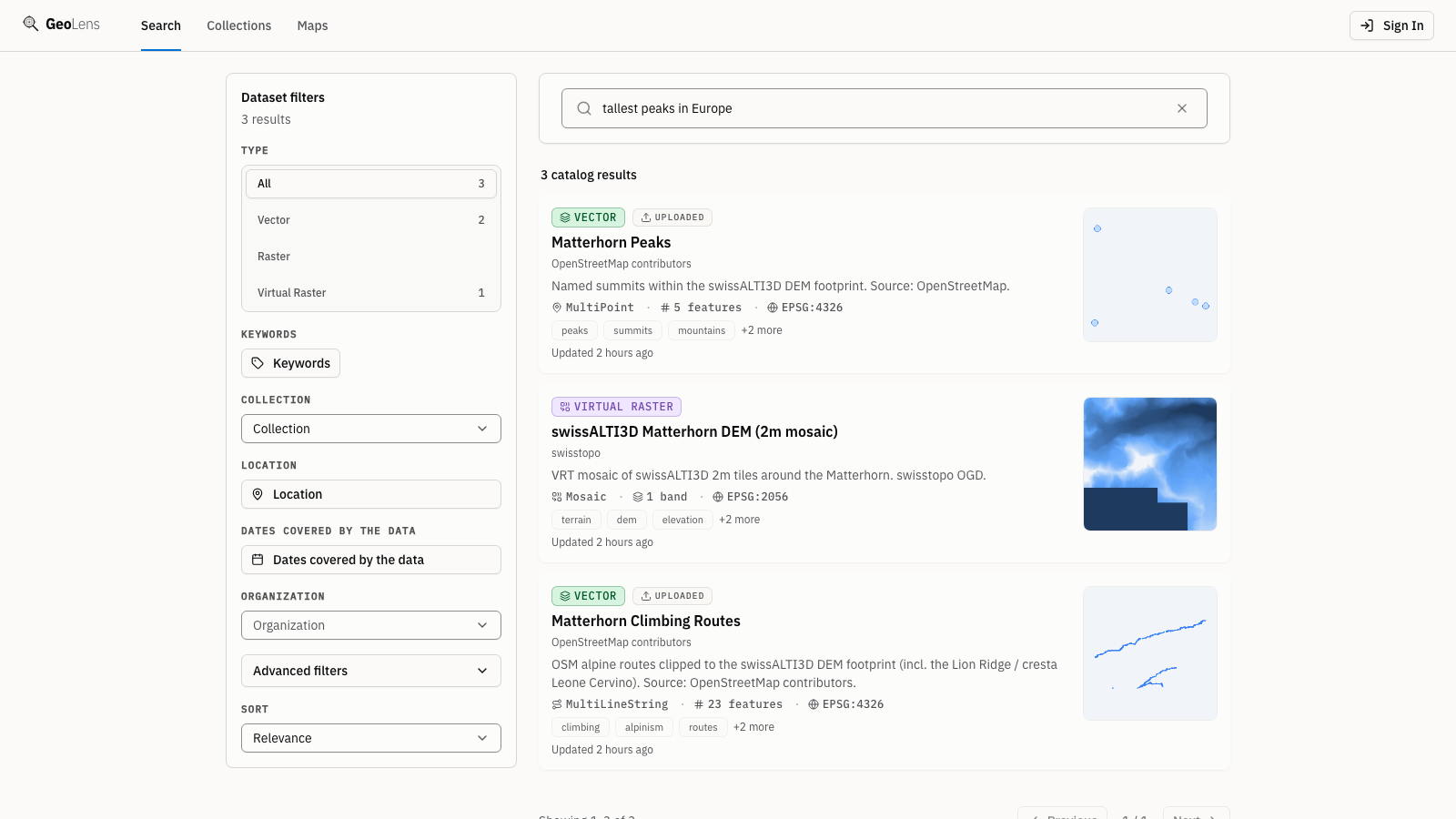
Ask for what you mean, not what someone named the file. Once an admin sets up semantic search and your catalog is indexed, "tallest peaks in Europe" finds your Matterhorn terrain model, whose name and metadata contain none of those words. Fuzzy keyword search works out of the box. Filter by type, geometry, CRS, or date, and preview datasets on a map before you download.
Create and share maps
Compose multi-layer maps in minutes
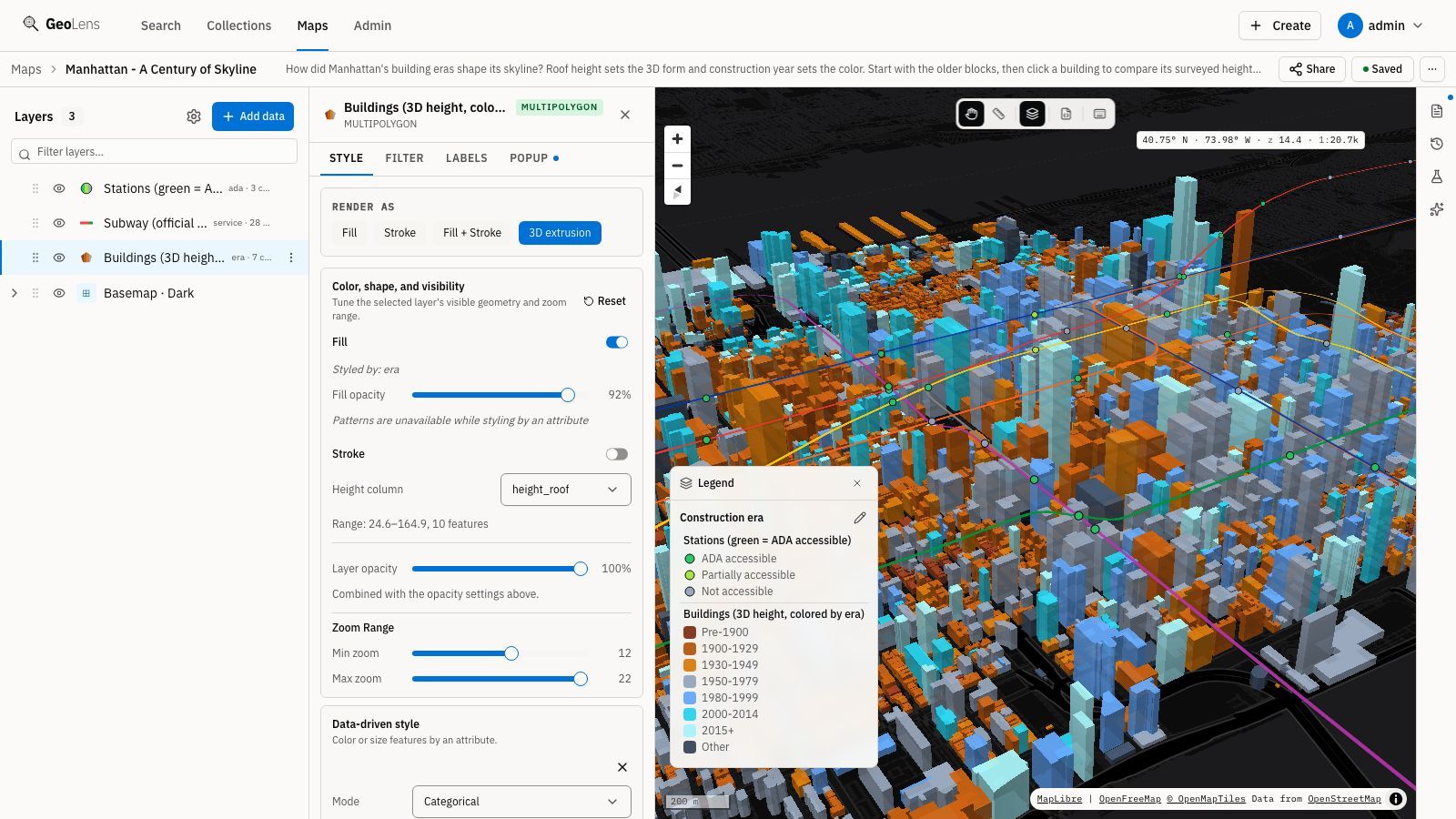
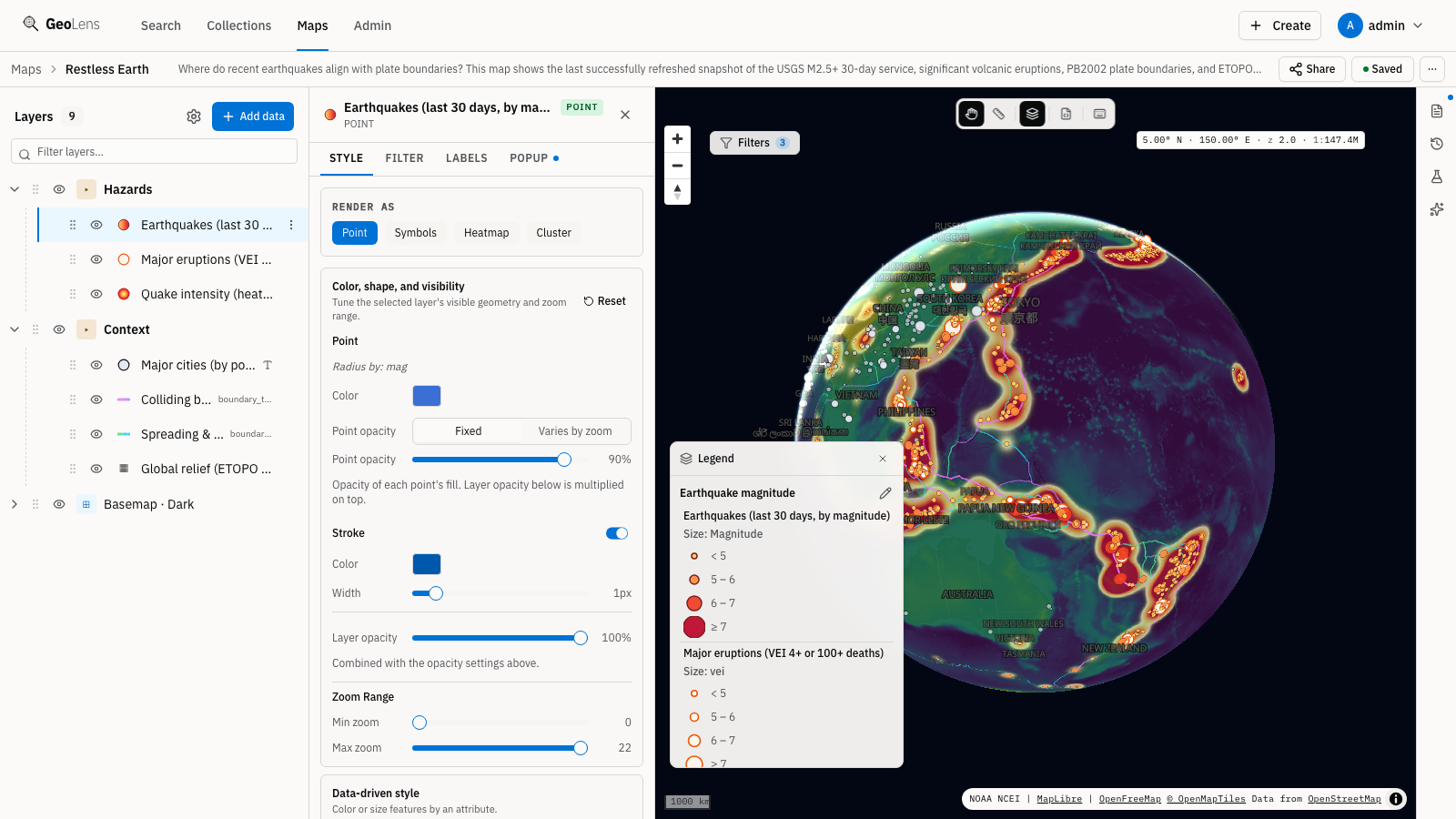
Combine vector and raster datasets with point-and-click layer controls: reorder layers, set color ramps and filters, draw and edit features, switch basemaps, and tilt into 3D terrain. Then share a live map with a public share link or embed code, without writing SQL or leaving the browser.
Self-hosted install
One command. Your data, your infrastructure.
You do not need a cloud account. The GeoLens catalog, map builder, APIs, CLI, and SDKs are open source under Apache 2.0 and free to self-host. Run GeoLens on a laptop, a VM, or your own servers with Docker Compose. An experimental community-maintained Helm chart covers Kubernetes.
How it works
One stack. One docker compose up.
Every GeoLens deployment is the same handful of services, orchestrated by a single compose file, with no external search engine and no tile server to run beyond the bundled Titiler.
- 1
Frontend
React + MapLibre UI: catalog, map builder, and 3D.
- 2
API
FastAPI: REST, OGC API, and tile endpoints.
- 3
Catalog & search
PostgreSQL + PostGIS + pgvector: spatial and semantic in one database.
- 4
Raster tiles
Titiler: Cloud-Optimized GeoTIFF tiling.
What GeoLens does
Everything your team needs to work with geospatial data
Search and semantic discovery
Fuzzy keyword search out of the box, plus pgvector semantic ranking once an admin sets up semantic search and the catalog is indexed, so a plain-English question finds datasets that share none of its search terms. Filter by type, geometry, CRS, or date. You do not need SQL.
Map builder & sharing
Compose multi-layer maps in minutes, then share them with a public share link or embed a live, interactive map in any page.
3D terrain
Bind a DEM and tilt into 3D: hillshade, terrain exaggeration, and your choice of basemap in the built-in map builder, powered by MapLibre. You do not need desktop GIS.
Raster and COG tiles
Ingest Cloud-Optimized GeoTIFFs and large rasters, build VRT mosaics, and serve tiles via Titiler with automatic colormaps, without running a separate tile server.
AI assist (optional)
Bring an OpenAI-compatible endpoint (a local server such as Ollama works) or Claude through Anthropic, Microsoft Foundry, Amazon Bedrock, or Google Vertex AI to ask about your catalog in plain language, create maps, and draft dataset descriptions. Optional: GeoLens runs fully without it, and AI stays inert until you configure a provider.
OGC API
Serve your datasets over OGC API - Features and Records, with CQL2 filtering on both and direct tile URLs for map clients. Compatible with QGIS, ArcGIS, and OGC clients.
Data ingestion
Drop in Shapefiles, GeoPackages, GeoJSON, GeoParquet, CSV, and XLSX, plus GeoTIFF and COG rasters. GeoLens validates, detects CRS, and indexes for you.
Self-hosted
Docker Compose on a laptop, a VM, or your own servers is the supported path. An experimental community-maintained Helm chart covers Kubernetes. Your infrastructure, your data; no cloud account required.
RBAC & access control
Admin, editor, and viewer roles with per-dataset permissions. OAuth (Google, GitHub, Microsoft, OIDC) and JWT sessions. Audit log included.
Why GeoLens
A modern alternative to heavyweight GIS stacks
One command, not a server farm
A single docker compose stack stands up the catalog, API, tiles, and UI, not a multi-image orchestration project.
A modern UI, by default
A React + MapLibre interface with a real map builder, not an afterthought UI on top of a data store.
Standards included, never paywalled
OGC API, STAC, and DCAT ship in the box, so your data stays portable and your existing clients keep working.
Your infrastructure, your data
Self-host on a laptop, a VM, or your own servers, even fully offline or air-gapped, with Kubernetes covered by an experimental community-maintained Helm chart. You do not need a cloud account, and GeoLens does not collect telemetry. Apart from the map tiles and fonts the default basemap loads from OpenFreeMap, outbound traffic comes only from the integrations you enable: AI, SSO, SMTP, or remote data. Plus an audit log of who did what.
Works with the tools you already run
Point QGIS or ArcGIS Pro straight at your OGC API URL, with no format conversion and no plugin to install. GeoLens fits alongside your existing stack instead of replacing it.
No lock-in, a clean exit
Your data stays in standard PostGIS and open formats, reachable and exportable over OGC API, STAC, and DCAT. Leaving does not require a migration project.
Who it's for
Built for teams that work with spatial data
GIS analysts & teams
Replace the tangle of shapefiles on a shared drive with one searchable catalog your whole team can preview, style, and share.
Data engineers
Serve datasets as OGC API Features, tiles, and STAC, straight into QGIS, ArcGIS, or your own clients, and script it all with the CLI.
Government & utilities
Keep sensitive data on your own network, on-prem or air-gapped, with no telemetry; the default basemap loads tiles and map fonts from OpenFreeMap, so review that on an isolated network. Role-based access, per-dataset scoping, and a full audit log are built in.
Civic tech & research
Publish open data catalogs on a permissive Apache 2.0 stack, with no licensing cost and no vendor lock-in.
Install GeoLens with one command
Run the public installer, log in, and upload your first dataset. It lands on your own infrastructure, not ours. The Quickstart also covers the source checkout path.
curl -fsSL https://getgeolens.com/install.sh | sh Or script it: automate GeoLens from the command line or your own code.